
Choosing the right plastic is often as important as the design itself. It determines the strength, the temperature resistance, the appearance and the cost of your part, as well as the manufacturing processes available. Here is an overview of the materials we use most often.
ABS: the all-rounder
ABS (acrylonitrile butadiene styrene) is one of the most widely used plastics in industry, from automotive interiors to consumer products. It offers good impact resistance, a surface that is easy to finish and a moderate cost. It is available in 3D printing (FDM), in CNC machining, as an ABS-like resin in vacuum casting and, of course, in injection moulding. Its weak points: limited UV resistance, and it is not biodegradable.
ASA: ABS for outdoor use
ASA has properties very close to ABS, with much better resistance to UV light and weathering. It is a good choice for parts exposed to the sun.
PC (polycarbonate): tough and heat-resistant
Polycarbonate combines high impact strength with good heat resistance, and it exists in transparent grades. It is widely used for technical housings, protective covers and lighting parts. PC/ABS blends offer a good compromise between toughness and ease of processing.
PA (polyamide): strong and slightly flexible
Polyamides such as PA12 and PA6 are tough and wear-resistant. PA12 is the reference material for SLS and MJF 3D printing; PA6 and glass-filled grades (PA-GF) are common in machining and injection moulding for functional and mechanical parts.
PP (polypropylene): light and chemically resistant
Polypropylene is light, resists many chemicals and withstands repeated bending, which makes it ideal for clips, hinges and packaging. It is very common in injection moulding; its main weaknesses are low UV resistance and a limited working temperature.
PMMA: clear as glass
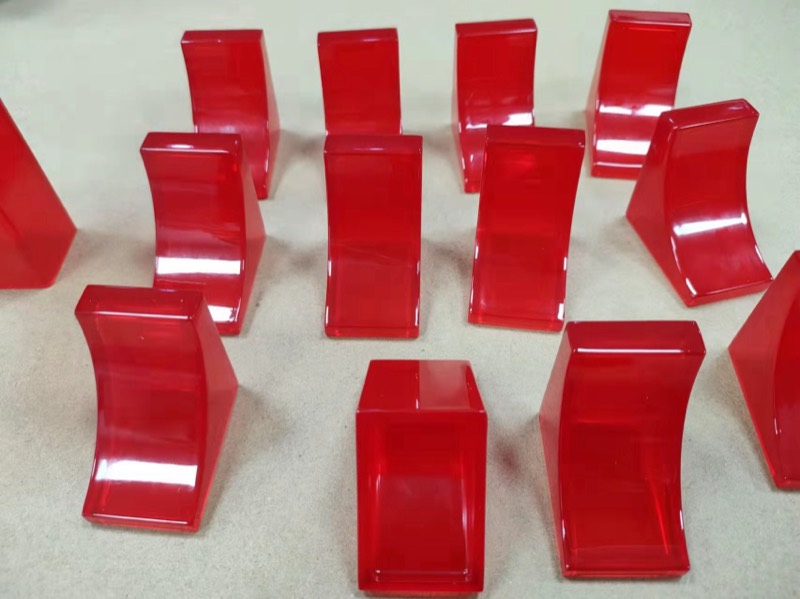
PMMA (acrylic) is chosen for its transparency and its glossy, scratch-resistant surface: covers, light guides, display parts. It can be machined and polished, cast as a clear PU resin, or injection moulded.
High-performance plastics: PEEK and ULTEM
PEEK and ULTEM (PEI) keep their mechanical properties at high temperatures and resist aggressive chemicals. Lighter than metals, they are used in aerospace, medical and demanding industrial applications, in machining, FDM printing or injection moulding.
Flexible materials: TPU and elastomers
For seals, grips or shock absorbers, TPU and rubber-like PU resins offer different levels of hardness, from soft to semi-rigid.
Resins for SLA and vacuum casting
SLA printing uses photosensitive resins that give a smooth, detailed surface, ideal for appearance models. In vacuum casting, PU resins reproduce the behaviour of ABS, PC, PP or rubber for pre-series of 20 to 200 parts.
Not sure which one to choose?
Tell us how your part will be used: loads, temperature, environment, appearance and quantities. We will recommend the right material and process in our quote.